Bicycle Intercom: Hands-Free Calling Keeps Cyclists Safe & Legal
- Using your phone while cycling is now illegal in Japan (¥12,000 fine), France (€135), Netherlands (€95), and more countries — earbuds are also banned in Japan (¥5,000)
- SCSETC BC01 pairs with your phone via Bluetooth: answer calls with one button on your helmet — phone stays in your pocket
- Helmet-mounted speakers (not earbuds) keep you aware of traffic sounds — compliant with earbuds bans
- GPS navigation plays through speakers — no need to look at your phone screen while riding
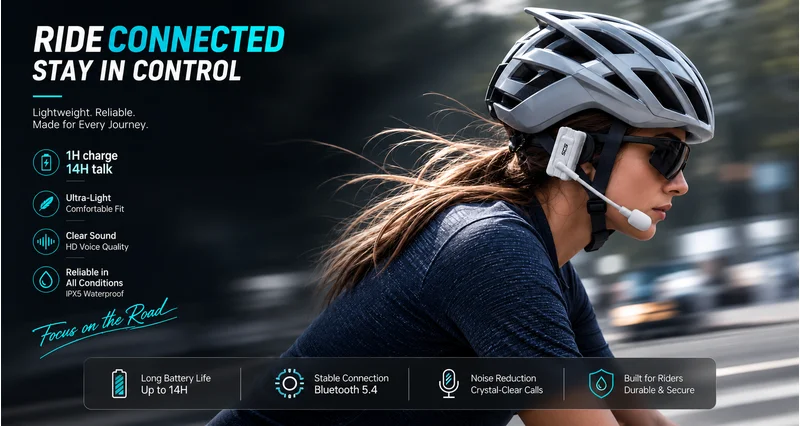
- 8-rider group communication, 1000m range, 14H battery, CVC noise cancellation, IP65 waterproof
You're cycling through an intersection. Your phone rings. Instinct tells you to reach for it — glance at the screen, maybe answer the call.
That split-second distraction is enough. A car you didn't see. A pedestrian stepping off the curb. A pothole you would have avoided.
And increasingly, that reach for your phone is also enough to get you fined.
In April 2026, Japan implemented a revised Road Traffic Act that makes it illegal to use a phone while cycling — with fines up to ¥12,000 (≈$80). Wearing earbuds while riding is also banned — ¥5,000 fine. France, the Netherlands, and other countries have similar laws. The global trend is clear: touching your phone while cycling is becoming illegal everywhere.
A bicycle intercom like the SCSETC BC01 solves this. It pairs with your phone via Bluetooth and lets you answer calls, hear GPS directions, and talk to other riders — all without touching your phone or putting earbuds in your ears. Your phone stays in your pocket. Your hands stay on the handlebars. Your ears stay open to traffic sounds.
The Law Is Clear: Phone Use While Cycling Is Illegal
Governments around the world are cracking down on distracted cycling. Here's the current landscape:
| Country | Phone Use Penalty | Earbuds/Headphones | Effective Date |
|---|---|---|---|
| Japan | ¥12,000 fine (≈$80) | ¥5,000 fine (earbuds banned) | April 1, 2026 |
| France | €135 fine | Banned (same penalty) | Long-standing |
| Netherlands | €95 fine | Banned | 2019 (tightened 2025) |
| UK | Up to £2,500 (careless cycling) | Advised against (no specific ban) | Ongoing |
| Spain | €200 fine | Banned | Long-standing |
Japan's 2026 revision is the most significant recent change. The new "blue ticket" (青切符) system allows police to issue on-the-spot fines to cyclists aged 16 and above — no warning, no second chance. Prior to this revision, Japan had cycling traffic rules but no penalty enforcement system. Now, enforcement is immediate.
What this means for cyclists:
- You cannot hold, look at, or operate your phone while riding — even briefly
- You cannot wear earbuds that block your awareness of surrounding sounds
- Using your phone for GPS navigation while riding is illegal (looking at a screen = operating the device)
- The fine for phone use alone (¥12,000) is the highest cycling penalty under the new system — higher than running a red light (¥6,000)
The reason is simple: distracted cycling kills. According to Tokyo Metropolitan Police data, cycling accidents involving phone use have risen year over year. A cyclist looking at their phone takes 2–3 seconds of full visual distraction — at 20 km/h, that's 11–17 meters of riding blind. In urban traffic, that distance can contain a car, a child, or an open sewer grate.
The Problem: You Still Need to Communicate
Here's the tension: the law says you can't use your phone or wear earbuds — but cyclists still need to:
- Answer important calls — a family emergency, a client calling, a delivery update
- Navigate unfamiliar routes — GPS is essential for touring and commuting
- Talk to riding partners — warn them about hazards, coordinate turns, share route info
Current "solutions" all violate the law or compromise safety:
- Bluetooth earbuds — illegal in Japan, France, Spain, Netherlands. They block ambient sound, reducing your awareness of approaching cars, sirens, and other cyclists.
- Phone mount on handlebars — technically "operating" the phone if you glance at the screen. GPS phone mounts are already being fined under Japan's new system.
- Speaker phone — you still have to reach for your phone to answer, and wind noise makes it impossible to hear at cycling speeds.
- Stop and answer — works, but inconvenient. And if you're commuting or touring, stopping every time your phone rings adds 10+ minutes to your ride.
None of these solve the core problem: you need hands-free communication that doesn't block your ears.
How SCSETC BC01 Solves This
The SCSETC BC01 bicycle intercom is designed around one principle: your phone stays in your pocket, your hands stay on the handlebars, your ears stay open.
Answer Calls Without Touching Your Phone
BC01 pairs with your smartphone via Bluetooth 5.4. When a call comes in, you hear the ring through the intercom's helmet-mounted speakers. Press one button on the intercom unit — mounted on your helmet, not your handlebars — and the call connects. The caller's voice comes through the speakers near your ears; your microphone picks up your voice through CVC noise cancellation.
Your phone never leaves your pocket. No reaching. No looking at a screen. No unlocking. No swiping. One button press, and you're talking.
Why this matters legally: Under Japan's revised Road Traffic Act, the fine is for "using" a phone — holding it, looking at it, or operating it. With BC01, you never touch your phone. The intercom unit is a separate device mounted on your helmet, operated by a single button press. This is analogous to a car's steering-wheel call button — accepted under driving regulations worldwide as hands-free operation.
Hear GPS Directions Without Looking at Your Screen
Once BC01 is paired with your phone, GPS navigation audio (Google Maps, Apple Maps, Waze, etc.) plays through the intercom speakers. You hear "turn left in 200 meters" without ever looking at your phone screen.
Intercom conversation with other riders pauses briefly for each GPS direction, then resumes automatically. You get both navigation and group communication in one system.
Why this matters legally: In Japan, looking at a phone screen for GPS while cycling is now a ¥12,000 offense. Audio-only GPS navigation through a helmet intercom is hands-free — no visual distraction, no screen interaction.
Speakers — Not Earbuds
This is the critical distinction for compliance with earbuds bans.
BC01 uses flat speakers that mount inside your helmet, positioned near your ears — not earbuds or headphones that insert into or cover your ear canal. The speakers sit against the helmet's interior padding, delivering audio at a volume that's audible over riding noise, but not blocking your awareness of surrounding sounds.
You hear the intercom audio AND you hear the car approaching from behind. You hear your riding partner's voice AND you hear the ambulance siren. You hear the GPS direction AND you hear the pedestrian calling out.
Why this matters legally: Japan's ¥5,000 earbuds fine specifically targets devices that "block or significantly reduce" the rider's ability to hear ambient sounds — the same standard used in France, Spain, and the Netherlands. Helmet-mounted speakers that don't cover or insert into your ear are not earbuds. They allow full ambient sound awareness, which is what regulators require.
8-Rider Group Communication
Beyond phone calls, BC01 provides intercom mode for up to 8 riders simultaneously. This replaces the need for group chat apps (which require phone interaction) or shouting (which is unreliable and exhausting).
- Lead rider: "Car approaching from the right — move left"
- Rear rider: "Pothole 20 meters ahead — watch your line"
- Anyone: "Slowing for the intersection — brake now"
All delivered in real-time, hands-free, to every rider in the group. No phone. No screen. No earbuds.
The Complete Hands-Free Cycling Setup
Here's how BC01 integrates into your ride — zero phone interaction required:
| Communication Need | Without BC01 (Illegal/Risky) | With BC01 (Hands-Free, Legal) |
|---|---|---|
| Answer a phone call | Reach for phone → ¥12,000 fine + danger | One button on helmet → call connected |
| GPS navigation | Look at phone screen → ¥12,000 fine + visual distraction | Audio directions through speakers → eyes on road |
| Listen to music | Earbuds → ¥5,000 fine + blocked awareness | Helmet speakers → hear music AND traffic |
| Talk to riding partner | Phone group chat → screen interaction | Intercom mode → real-time, hands-free |
| Hazard warning to group | Shouting → unreliable, exhausting | Intercom → instant, clear, to all 8 riders |
BC01 Specs That Matter for Cycling
Beyond the hands-free calling that keeps you legal, BC01 delivers the performance features cyclists need:
| Feature | BC01 Spec | Why It Matters for Cycling |
|---|---|---|
| Rider capacity | 8 riders | Most cycling groups are 4–8 riders; 2-person intercoms leave half the group disconnected |
| Intercom range | 1000m rated / 500–700m real | Lead rider warns rear rider about hazards 30 seconds before they arrive |
| Bluetooth version | 5.4 | Latest standard — faster pairing, more stable connection, lower power draw |
| Battery life | 14 hours | Full touring day + spare; weekly commuter use on one charge |
| Noise cancellation | CVC | Filters wind noise at cycling speeds; your voice comes through clean |
| Waterproof | IP65 | Rain-proof — ride through downpours without damage |
| Mounting | Adhesive pad + clamp | Fits thin-shell cycling helmets where clamp mounts can't grip |
Why Earbuds Are Not the Answer
Many cyclists think Bluetooth earbuds solve the phone problem — they're wireless, after all. But earbuds fail on both legal and safety grounds:
Legal failure: Earbuds are explicitly banned under Japan's revised Road Traffic Act (¥5,000 fine), France's cycling regulations (€135 fine), Spain's traffic law (€200 fine), and the Netherlands' cycling rules (€95 fine). The legal reasoning is consistent across all these countries: earbuds reduce or block the rider's ability to hear ambient sounds — traffic, sirens, warnings — which creates danger.
Safety failure: Even in countries without specific earbuds bans (like the UK), cycling safety organizations strongly advise against them. Research consistently shows that auditory awareness — hearing approaching vehicles, other cyclists, and emergency sirens — is a critical component of cycling safety, second only to visual awareness. Earbuds that block or muffle ambient sound reduce your reaction time to hazards by 2–4 seconds.
BC01's helmet-mounted speakers are designed to deliver audio without blocking ambient sound. The speakers sit near your ears, inside your helmet, but they don't seal or cover your ear canal. Audio is delivered at a volume sufficient to hear over riding noise, but ambient sounds (car engines, horns, sirens, other cyclists) pass through naturally.
This is the same approach used in motorcycle intercoms worldwide — and motorcycle intercoms are explicitly accepted under vehicle regulations in every major market. The principle: audio delivery that preserves ambient awareness is legal; audio delivery that blocks awareness (earbuds, headphones) is not.
Motorcycle Intercom vs. Bicycle Intercom: Which for Cyclists?
Some cyclists consider using a motorcycle intercom since the technology is similar. But there are practical differences that make a bicycle-specific intercom like BC01 a better choice:
| Feature | Motorcycle Intercom | SCSETC BC01 (Bicycle) |
|---|---|---|
| Mounting | Clamp only (needs thick shell) | Adhesive pad + clamp (fits thin cycling helmets) |
| Group size | 2–6 riders typical | 8 riders |
| Hands-free calling | Yes | Yes — same Bluetooth phone pairing |
| Wind noise filtering | Optimized for 80+ km/h | Optimized for 15–30 km/h cycling speeds |
| Speaker type | Helmet-mounted (legal) | Helmet-mounted (legal, same design) |
| Battery | 8–12 hours | 14 hours |
| Bluetooth | 5.0–5.3 common | 5.4 |
The key practical issue: motorcycle intercom clamp mounts are designed for 4–6mm helmet shells. Most cycling helmets have 1–2mm shells — the clamp won't grip, and the unit slips off. BC01's adhesive pad mount solves this, attaching securely to thin-shell helmets.
Practical Tips: Set Up BC01 for Hands-Free Riding
- Pair before riding: Connect BC01 to your phone via Bluetooth before you start. Pairing takes 30 seconds; doing it while riding would require phone interaction (illegal).
- Set phone to auto-answer or voice command: Some phones support voice-activated answering ("answer call" spoken command). Combined with BC01, this means zero button presses for incoming calls — truly hands-free.
- Position speakers outside your ear canal: Speakers should sit against the helmet's interior padding near your ears, not pressed into your ear. This keeps ambient sound flowing naturally — both legal compliance and safety best practice.
- Mount the intercom unit on the helmet's rear or side: Avoid blocking helmet vents. The rear-center position is common — easy to reach the button without moving your hand far from the handlebars.
- Use short callouts in group mode: "Car right!", "Pothole ahead", "Slowing" — brief, specific alerts process faster than detailed explanations at cycling speed.
- Let GPS audio handle navigation: Don't look at your phone screen for map confirmation. Trust the audio directions — they're accurate and they keep your eyes on the road (and keep you legal).
Bicycle Intercom FAQ
Is it illegal to use a phone while cycling?
Yes — in many countries. Japan's revised Road Traffic Act (effective April 1, 2026) fines cyclists ¥12,000 for using a phone and ¥5,000 for wearing earbuds. France fines €135. The Netherlands fines €95. UK cyclists can face £2,500 for careless cycling including phone use. Spain fines €200. More countries are tightening regulations every year.
How does SCSETC BC01 let you answer calls hands-free?
BC01 pairs with your phone via Bluetooth 5.4. When a call comes in, you press one button on the intercom unit mounted on your helmet — no need to reach for your phone. The caller's voice comes through speakers near your ears (not earbuds inside them), and your microphone picks up your voice. Your phone stays in your pocket the entire ride.
Does wearing a bicycle intercom with speakers violate earbuds laws?
No. Laws like Japan's ban specifically target earbuds or headphones that block or cover your ears, reducing awareness of ambient sounds. SCSETC BC01 uses helmet-mounted speakers positioned near — not inside — your ears. You hear both the intercom audio and surrounding traffic sounds, which is what regulators require.
How many cyclists can talk at the same time?
With SCSETC BC01 or BC02, up to 8 riders can communicate simultaneously in group intercom mode. In universal pairing mode, 2 riders can talk across different intercom brands.
What is the real-world range of a bicycle intercom?
SCSETC BC01/BC02 are rated for 1000m. In real-world conditions with buildings, trees, and obstacles, expect 500–700m of reliable communication. Open road conditions can approach 1000m.
Can bicycle intercoms connect to phone GPS navigation?
Yes. SCSETC BC01/BC02 pair with your smartphone via Bluetooth. GPS turn-by-turn directions play through the intercom speakers — you hear navigation without looking at your phone screen. Intercom conversation with other riders resumes automatically after each direction.
The Bottom Line
The law is changing fast. Japan's 2026 revision made phone use while cycling a ¥12,000 offense — and earbuds a ¥5,000 offense. France, Spain, and the Netherlands already enforce similar bans. More countries will follow.
Cyclists who reach for their phone on the road are breaking the law and risking their safety. Cyclists who wear earbuds are doing the same — blocking the ambient awareness that keeps them alive in traffic.
SCSETC BC01 and BC02 offer a solution that works within the law and enhances safety: hands-free calling, GPS audio navigation, and group communication through helmet-mounted speakers — no phone touch, no earbuds, no fines.
Your phone stays in your pocket. Your hands stay on the handlebars. Your ears stay open. You stay connected. You stay legal. You stay safe.
Interested in bicycle intercoms for your cycling team or club? Contact SCSETC for bulk pricing, OEM customization, or distribution partnerships.