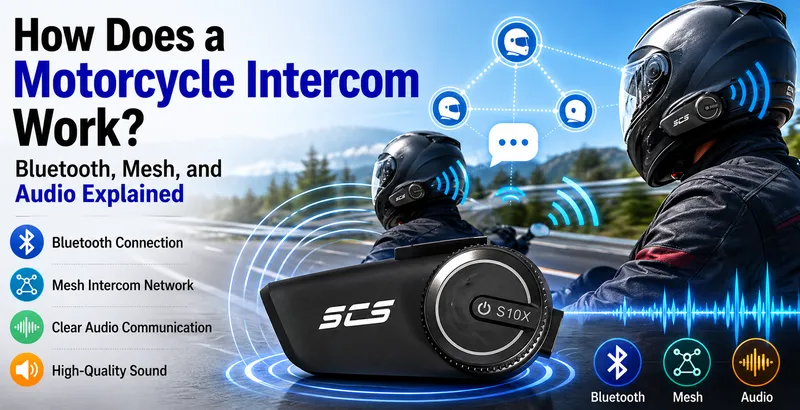
How Does a Motorcycle Intercom Work? Bluetooth, Mesh, and Audio Technology Explained
- Intercoms use Bluetooth or MESH protocols to connect riders wirelessly
- Bluetooth uses daisy-chain: Rider A → B → C (chain breaks if one disconnects)
- MESH creates a self-healing network: any rider can join/leave without breaking the group
- Audio is compressed and transmitted at low latency (~50ms for Bluetooth, ~10ms for MESH)
- SCSETC MESH models support both modes — MESH for groups, Bluetooth for 1-to-1
You clip a small unit onto your helmet, pair it with another rider, and suddenly you can talk at 70 mph without hand signals. But what's actually happening between those two helmet units? How does your voice travel from your microphone to the other rider's speakers through wind, engine noise, and 1000 meters of open road?
This guide explains the technology behind motorcycle intercoms — from radio frequencies to noise cancellation algorithms — in plain language. No engineering degree required.
The Basics: What's Inside an Intercom Unit
Every motorcycle intercom contains the same core components, regardless of brand or model:
- Microphone: Captures your voice. Boom mic (for open-face/half helmets) or wired mic (for full-face helmets).
- Speaker(s): Play incoming audio — other rider's voice, music, GPS directions. Typically two speakers (left + right) for stereo.
- Bluetooth chip: Handles wireless communication. This is the brain — it encodes, transmits, receives, and decodes audio signals.
- Processor (DSP): Optional. Some models add a separate Digital Signal Processing chip for advanced noise cancellation.
- Battery: Lithium-ion, typically 400–800 mAh. Powers everything for 8–20 hours depending on usage mode.
- Antenna: Internal. Transmits and receives the 2.4 GHz radio signal. Range depends on antenna design and transmit power.
- Buttons/controls: Physical interface for pairing, volume, mode switching. Some models also support voice commands.
The entire unit weighs about 30–60 grams — light enough that you forget it's on your helmet once you start riding.
How Bluetooth Intercom Works (Point-to-Point)
Most motorcycle intercoms use Bluetooth for rider-to-rider communication. Here's what happens when you speak:
Step 1: Voice Capture
Your microphone picks up your voice plus surrounding noise (wind, engine, traffic). The raw audio signal is analog — a continuous electrical waveform.
Step 2: Noise Filtering
Before transmitting, the intercom processes the raw audio. CVC or DSP algorithms identify your voice frequency range (300–3400 Hz) and suppress everything else. Wind noise (broad spectrum), engine rumble (low frequency), and traffic noise (various frequencies) are filtered out. Your voice signal is isolated.
Step 3: Digital Encoding
The filtered analog voice signal is converted to digital data. Bluetooth uses codec algorithms (typically SBC or aptX) that compress the audio into data packets small enough to transmit over the 2.4 GHz radio channel. This happens in milliseconds — you don't notice any delay in conversation.
Step 4: Radio Transmission
The Bluetooth chip transmits the encoded data packets via the 2.4 GHz radio frequency band — the same band used by Wi-Fi, microwave ovens, and car key fobs. Bluetooth uses adaptive frequency hopping to avoid interference: it rapidly switches between 79 available channels within the 2.4 GHz band, staying on each channel for only 625 microseconds before jumping to the next. This prevents static interference from other 2.4 GHz devices.
Step 5: Reception and Decoding
The other rider's intercom receives the radio signal, decodes the compressed data packets back into audio, and sends the signal to the speakers. The entire process — voice → filter → encode → transmit → receive → decode → speaker — takes roughly 50–150 milliseconds. That's fast enough for natural conversation.
Bluetooth Limitations
- Point-to-point only: Bluetooth intercom connects exactly two units. If you want to add a third rider, one unit must "bridge" connections — Rider A connects to Rider B, Rider B connects to Rider C. Rider A and Rider C communicate through Rider B. If Rider B drops out, A and C lose connection.
- Range: Bluetooth Class 1 devices transmit up to ~100m (theoretical 100m, practical 30–50m on a motorcycle due to antenna size constraints). Intercoms claiming 1000m range use a proprietary long-range Bluetooth protocol with higher transmit power, but real-world range is typically 500–800m in open terrain.
- Rider count: Standard Bluetooth intercom supports 2 riders directly. Some models add multi-hop bridging for up to 4 riders, but audio quality degrades with each hop.
How Mesh Intercom Works (Networked Communication)
Group intercom solves Bluetooth's limitations. SCSETC's S13 uses DMC (Dynamic Mesh Communication) technology, while the T2 Plus provides 10-rider group connectivity. Here's how they work differently:
Every Rider Is a Node
In a mesh network, every intercom unit acts as both a transmitter AND a relay. Unlike Bluetooth's point-to-point model, mesh creates a web of connections:
- Rider A connects to Rider B AND Rider C directly
- Rider B connects to Rider A AND Rider C AND Rider D
- If Rider B rides ahead, Riders A, C, and D still stay connected through other relay paths
The network is self-organizing. Riders don't need to pair manually — when you turn on a mesh intercom near other mesh units, you join the network automatically. No pairing button, no configuration.
Self-Healing
This is mesh's biggest advantage. If a rider drops out of range, the network automatically reroutes through remaining riders. Example:
- 5 riders in a mesh group: A-B-C-D-E
- Rider C speeds ahead and drops out of range of A and B
- The network reroutes: A connects through B → D → E → back to C
- Everyone stays connected. No re-pairing needed.
In a Bluetooth chain, losing Rider C breaks the entire chain. In mesh, losing one rider just reroutes the network. This is why mesh is the standard for group riding with 3+ riders.
Dynamic Range Extension
Bluetooth range is fixed — 1000m between two units, period. Mesh range expands as more riders join. Two mesh riders have a base range of ~1000m. But in a group of 6 riders spread across a mile of road, each rider is a relay point — the effective network range extends far beyond what any single Bluetooth connection could achieve.
Bluetooth vs Mesh: How They Compare
| Feature | Bluetooth Intercom | Mesh Intercom |
|---|---|---|
| Connection type | Point-to-point (A → B) | Networked (every rider connects to every other rider) |
| Max riders | 2–4 (degrades with bridging) | 6+ (no degradation) |
| Pairing | Manual button pairing required | Automatic — just turn it on near other mesh units |
| Self-healing | No — if one link drops, the chain breaks | Yes — network reroutes automatically |
| Range | Fixed (1000m between two units) | Dynamic — expands with more riders |
| Audio quality at distance | Decreases with range | Stable across network |
| Best use case | 2 riders, rider + passenger | Group riding 3+ riders |
| SCSETC models | S9XM, S10X | T2 Plus, S13 |
How the Speakers Work
Intercom speakers aren't like regular headphones. They're designed for a helmet environment:
- Size: 30–40mm diameter — small enough to fit inside helmet ear pockets. Larger than earbuds but smaller than over-ear headphones.
- Output: 85–100 dB maximum volume. This needs to overcome wind noise (90+ dB) while remaining clear. The speaker must be loud enough to cut through ambient noise without distortion.
- Placement: Inside the helmet lining, flush against your ear. On full-face helmets, speakers sit in the ear pockets. On half/open-face helmets, thin speakers clip onto the helmet lining near your ear.
- Stereo vs mono: Most intercoms use stereo speakers (left + right) for music playback, but switch to mono for intercom voice communication. Voice doesn't need stereo — it actually sounds clearer in mono because both ears receive the same signal.
The speaker quality directly affects what you hear. Cheap speakers produce tinny, distorted audio. Quality speakers (like those in SCSETC models with Hi-Fi audio support) deliver clear voice and enjoyable music even at highway speed.
How Noise cancellation Works
Noise cancellation is what makes intercom conversations possible at speed. Without it, the other rider hears wind noise, not your voice. The three technologies work differently:
- CVC (Clear Voice Capture): Built into the Bluetooth chip. Uses a single microphone. Analyzes the audio signal, identifies your voice frequency pattern, and suppresses everything else. Works well up to ~60–80 mph. Used on S7X and X1.
- DSP (Digital Signal Processing): Separate processor chip. More powerful than CVC — can filter multiple simultaneous noise sources (wind + engine + traffic). Handles highway speeds up to ~100 mph. Filters both outgoing voice AND incoming audio. Used on S9XM, S10X, T2 Plus.
- ENC (Environmental Noise Cancellation): Two microphones — one near your mouth (voice mic) and one on the unit body (noise reference mic). The processor subtracts the noise reference from the voice signal, leaving only your voice. Most aggressive filtering available. Essential for half helmets and very high speeds.
For a deeper comparison, see our noise cancellation guide.
How the Phone Connection Works
Your intercom also connects to your smartphone for music, GPS, and phone calls. This is a separate Bluetooth connection from the intercom-to-intercom channel:
- Two Bluetooth connections simultaneously: One connection to the other rider's intercom (intercom channel), one connection to your phone (A2DP/HFP channel). Modern Bluetooth chips handle both at once.
- Priority system: Intercom voice takes priority over music. When another rider speaks, music automatically pauses or reduces volume. When the conversation ends, music resumes. This prevents you from missing important communication.
- Phone calls override everything: An incoming phone call pauses both music and intercom conversation. After the call ends, everything resumes.
- GPS audio shares the A2DP channel: Navigation apps stream through the music channel. GPS announcements lower music volume briefly, then music returns to normal.
How Music Sharing Works
Some SCSETC models (like the S10X and T2 Plus) support music sharing between riders:
- Bluetooth music sharing (S10X): Rider A plays music on their phone. The S10X transmits the audio stream to Rider B's S10XM over the intercom channel. Both riders hear the same song simultaneously. One rider controls playback.
- Group music sharing (T2 Plus): Any rider in the mesh group can share their music. The audio streams through the mesh network to all connected riders. Multiple riders can take turns sharing — the current sharer's music plays for everyone.
Music sharing reduces intercom range slightly because it uses part of the radio bandwidth for audio streaming. Voice communication still works during music sharing — the priority system lowers music volume when someone speaks.
How Intercom Range Actually Works
Intercoms advertise ranges like "1000m" or "1500m", but real-world range is always shorter. Here's why:
- Line of sight matters: The 2.4 GHz signal travels in a relatively straight line. Trees, buildings, hills, and even other vehicles block it. Open highway range is close to the advertised number; urban range drops to 200–400m.
- Rider position matters: Two riders side-by-side have better range than riders staggered (one ahead, one behind) because the antenna orientation changes.
- Speed reduces effective range: At higher speeds, you cover more distance per second. If your intercom has 800m practical range and you're riding at 80 mph (~36 m/s), you'll lose connection faster than at 30 mph. The signal needs time to transmit — you're moving out of range while it travels.
- Battery level affects transmit power: Low battery reduces transmit power. At 10% battery, range may be 30–50% shorter than at full charge.
For detailed range data, see our range explained article.
FAQ
Can I use my intercom without connecting to my phone?
Yes. Intercom-to-intercom communication works independently — no phone needed. Two helmet units pair directly and transmit voice between each other. You only need a phone connection for music streaming, GPS audio, and phone calls.
Why does my intercom sometimes have a delay?
A slight delay (50–150ms) is normal — it's the time required for encoding, transmitting, and decoding audio. Bluetooth has more delay than mesh because of the codec compression step. If the delay becomes noticeable (>200ms), check your battery level and Bluetooth connection quality. Low battery and weak signal increase processing latency.
Can two different intercom brands communicate?
It depends. Some brands support universal intercom pairing (a standard protocol that allows cross-brand communication). SCSETC intercoms can pair with certain Sena and Cardo models using universal pairing mode. However, cross-brand connections typically have shorter range and may not support advanced features like music sharing. See our cross-brand pairing guide for compatibility details.
Why does my intercom connect to my phone but not to another rider?
Because phone pairing and intercom pairing use different Bluetooth protocols. Phone pairing uses standard Bluetooth A2DP/HFP (audio/call protocol). Intercom pairing uses a proprietary intercom protocol. You must specifically enter intercom pairing mode — it's not the same as pairing your phone. Check your user manual for the intercom pairing button sequence.
The Bottom Line
Motorcycle intercoms aren't magic — they're radio communication devices that use the same 2.4 GHz frequency as your wireless mouse and kitchen appliances. The difference is in the engineering: noise cancellation algorithms that extract your voice from 100 dB wind noise, adaptive frequency hopping that avoids interference, and mesh networking that keeps groups connected without manual pairing.
Understanding how the technology works helps you choose the right model:
- Solo riders: Bluetooth intercom with CVC noise cancellation — S7X or X1
- 2 riders: Bluetooth intercom with DSP — S9XM or S10X
- Groups 3+: Group intercom with auto-connect — T2 Plus or S13
Match the technology to your riding needs, and you'll get an intercom that actually works at speed — not just in the parking lot.