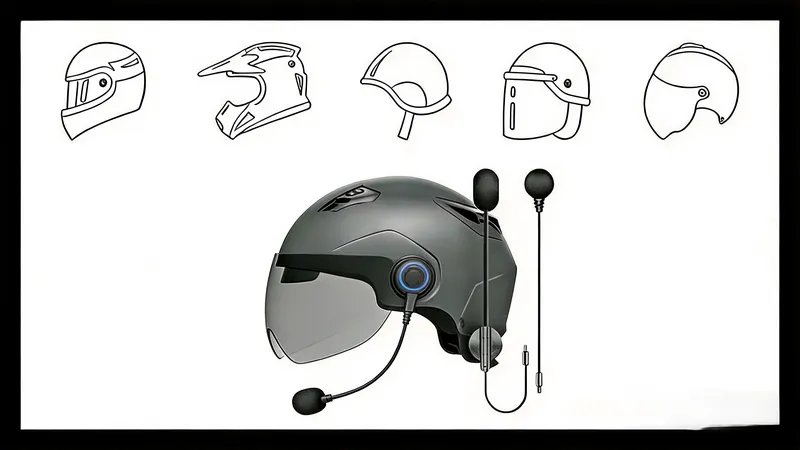
Best Motorcycle Intercom for Half Helmet: What Works and What Doesn't
- Half helmets lack chin bars and ear pockets — intercom mounting is a challenge
- Boom microphones work best with half helmets (1–2 inches from your mouth)
- SCSETC S13 and T2 Plus use boom mics — the best options for open-face/half helmets
- Avoid wired-mic models (designed for full-face helmets only)
- Use stick-on speaker pads and velcro for secure mounting on half helmets
If you ride with a half helmet — also called a skull cap, beanie, or shorty — you already know that most motorcycle gear isn't designed for you. Full-face and modular helmets dominate the market, and most intercom manufacturers build their products around clamp mounts that grip a full visor edge.
But half helmet riders still want music, GPS directions, phone calls, and rider-to-rider communication. The challenge is finding an intercom that actually fits, stays secure, and delivers clear audio when your ears and mouth are exposed to wind noise.
This guide breaks down exactly what works and what doesn't when choosing a motorcycle intercom for a half helmet — and which models are worth your money.
The Problem: Why Most Intercoms Don't Fit Half Helmets
Half helmets create three specific problems for intercom installation:
- No ear pockets: Full-face helmets have deep ear cavities that house speakers flush against your ears. Half helmets have no lining at the ear area — speakers have nowhere to sit inside the helmet.
- No clamp surface: The standard intercom clamp mount grips the bottom edge of a full-face helmet visor. Half helmets have a short, thin edge that can't support a clamp. It slips off or damages the shell.
- Extreme wind noise: With your face fully exposed, wind noise at highway speeds hits 90–100 dB. Without a sealed helmet environment, noise cancellation becomes critical — not optional.
These aren't minor inconveniences. They're fundamental design mismatches that make most full-face intercoms impractical on half helmets.
Mounting Options for Half Helmets
Since clamp mounts won't work, half helmet riders have two realistic mounting options:
1. Adhesive Pad Mount
The adhesive pad is the most common solution. It works like this:
- Clean the left or right side of your helmet shell with rubbing alcohol
- Attach the adhesive pad (included with most SCSETC intercoms)
- Slide the intercom base onto the pad — it clicks in and stays secure
- The intercom unit sits on the outside of the helmet, speakers and mic connect inside
Pros: Works on any smooth helmet surface, no drilling, no shell damage, easy to remove and reposition.
Cons: Can weaken over time in extreme heat; not ideal if you switch helmets frequently.
2. Helmet Strap Clip
Some ultra-compact intercoms (like the SCSETC X1) clip directly onto the helmet retention strap behind your ear. No pad, no adhesive, no shell attachment.
Pros: Zero adhesive, transfers between helmets instantly, very low profile.
Cons: Limited to compact, lightweight intercoms; mic placement may vary depending on strap position.
Speaker Solutions for Half Helmets
Without ear pockets, where do the speakers go? There are three practical approaches:
- Clip-on ear speakers: Thin speakers that clip onto the helmet lining near your ear. They sit between the helmet shell and your ear — not flush inside a pocket, but close enough for decent audio. This is the standard approach for SCSETC intercoms.
- In-ear monitors (IEMs): Some riders swap the helmet speakers for wired in-ear buds. This gives much better audio isolation against wind noise, but adds a wire and can be uncomfortable after an hour.
- External speakers: A few intercom models have small external speakers that sit on the helmet surface. Audio quality is poor at speed because wind noise overwhelms the output.
For most half helmet riders, clip-on ear speakers paired with strong noise cancellation (like CVC or DSP) provide the best balance of convenience and audio clarity.
Best Intercoms for Half Helmets
For Solo Riders: Music, Calls, GPS
If you ride alone and want music streaming, phone calls, and GPS audio through your helmet, you need a compact, single-rider intercom with excellent noise cancellation and adhesive/clip mounting.
SCSETC S7X — Best overall for half helmet solo riders
| Feature | S7X |
|---|---|
| Bluetooth version | 5.3 |
| Noise cancellation | CVC intelligent noise cancellation |
| Water resistance | IP65 |
| Mounting | Adhesive pad + clamp (adhesive recommended for half helmets) |
| Music/Audio | Hi-Fi stereo, A2DP |
| Battery life | Up to 12 hours music playback |
| Weight | Lightweight, low-profile unit |
Why it works for half helmets: The S7X's adhesive pad mount sticks securely to any smooth helmet surface. CVC noise cancellation is essential when your ears are exposed to wind — it filters out the constant 90+ dB wind roar so you can hear music and calls clearly. Bluetooth 5.3 gives a stable phone connection even at highway speed. And the IP65 rating means rain won't kill it.
SCSETC X1 — Ultra-compact clip-on option
The X1 clips directly onto your helmet strap — no adhesive needed. It's the simplest install possible for a half helmet. Same Bluetooth 5.3 and music/call features as the S7X, but without the intercom-to-intercom communication feature (it's a solo rider unit). If you only need music and phone calls and want zero adhesive, the X1 is the cleanest option.
For Rider-to-Rider Communication
If you ride with a passenger or a group and need intercom communication, you need a model that supports rider pairing — and still mounts on a half helmet.
SCSETC S9XM — 2-rider Bluetooth intercom
| Feature | S9XM |
|---|---|
| Intercom range | Up to 1000m (2 riders) |
| Noise cancellation | DSP noise cancellation |
| Water resistance | IP65 |
| Mounting | Adhesive pad + clamp |
| Music sharing | Yes (A2DP sharing between 2 riders) |
| Battery life | Up to 12 hours intercom, 20 hours music |
The S9XM gives you rider-to-rider communication up to 1000m — enough for riding with a passenger or a close buddy. DSP noise cancellation handles wind noise well. The adhesive pad mount works on half helmets the same way as the S7X. Music sharing lets both riders hear the same playlist.
SCSETC T2 Plus — Group intercom for group riding
If you ride in groups of 3–6 riders, mesh networking is the way to go. The T2 Plus uses DMC mesh technology — riders connect automatically, no manual pairing, and the network self-heals if a rider drops out. Range extends dynamically as more riders join.
On a half helmet, the T2 Plus mounts with the adhesive pad. It's a slightly larger unit than the S9XM, but still manageable on a half helmet shell. The mesh network's auto-reconnect feature is especially valuable for half helmet riders — since wind noise makes manual pairing frustrating, the mesh just connects you automatically.
What to Avoid on a Half Helmet
- Clamp-mount-only intercoms: Some brands only offer clamp mounts with no adhesive pad option. These simply won't work on a half helmet — don't buy them.
- Large, heavy intercom units: A bulky intercom on a small half helmet shell looks awkward and can pull the adhesive pad off over time. Stick with compact, lightweight models.
- Intercoms without noise cancellation: On a half helmet, wind noise is your biggest enemy. An intercom without CVC, DSP, or equivalent noise cancellation will give you muffled, wind-drowned audio. This is not optional — it's mandatory.
- In-ear-only systems: Some ultra-minimalist systems use only wired earbuds with no helmet-mounted unit. They're fine for music, but you can't do intercom communication, and the wires are annoying.
Installation Tips for Half Helmet Intercoms
- Clean the shell surface before adhesive mounting: Use rubbing alcohol on the spot where the pad will go. Dirt and oils weaken adhesive grip.
- Position the intercom on the left side: Left-side placement keeps the mic closer to your mouth and avoids blocking your right-side peripheral vision.
- Test speaker position before committing: Clip-on speakers need to sit close to your ear. Slide them around the helmet lining until you find the position where audio is loudest and clearest — then secure them.
- Use a boom microphone: Half helmets can't use a wired mic inside the helmet. A boom mic that extends from the intercom unit toward your mouth is the standard setup.
- Check adhesive pad condition monthly: Heat and vibration can weaken the adhesive over time. Inspect the pad and replace if it's peeling.
Half Helmet Intercom Quick Comparison
| Model | Best For | Mounting | Noise Cancel | Riders |
|---|---|---|---|---|
| S7X | Solo: music, calls, GPS | Adhesive pad | CVC | 1 |
| X1 | Solo: simplest install | Strap clip | CVC | 1 |
| S9XM | 2-rider communication | Adhesive pad | DSP | 2 |
| T2 Plus | Group mesh riding | Adhesive pad | DSP | 2–6 |
FAQ: Half Helmet Intercoms
Can you use a motorcycle intercom on a half helmet?
Yes — but you need an intercom with adhesive pad mounting and strong noise cancellation. Clamp mounts don't grip half helmet edges. Wind noise demands CVC or DSP noise cancellation. The SCSETC S7X, X1, S9XM, and T2 Plus all include adhesive pads and noise cancellation.
Will speakers stay in place on a half helmet?
Clip-on speakers attach to the helmet lining near your ears. They stay in place during normal riding, though very high speeds can shift them slightly. For maximum stability, use speakers with a secure clip mechanism (all SCSETC models include this).
Is wind noise really that bad on a half helmet?
At 60 mph, wind noise on a half helmet reaches approximately 90–95 dB — comparable to a lawnmower. At 80 mph, it can exceed 100 dB. Without noise cancellation, you'll struggle to hear anything through your intercom. This is why CVC/DSP noise cancellation is non-negotiable for half helmet riders.
Can I use in-ear monitors instead of helmet speakers?
Yes, and many half helmet riders do. In-ear monitors provide excellent wind noise isolation and audio clarity. The trade-off is comfort — wired IEMs can irritate your ears after long rides, and you lose the convenience of clip-on speakers. Some riders use IEMs for highway stretches and clip-on speakers for city riding.
The Bottom Line
Half helmet riders aren't left out of the intercom market — but they need to choose wisely. The three requirements are: adhesive pad or strap-clip mounting (no clamp), strong noise cancellation (CVC or DSP), and compact size (no bulky units).
The SCSETC S7X hits all three for solo riders. The X1 is the simplest clip-on option. The S9XM adds rider-to-rider communication. And the T2 Plus brings mesh networking for group rides.
Need help choosing the right intercom for your half helmet? Contact us — we'll help you find the perfect fit.